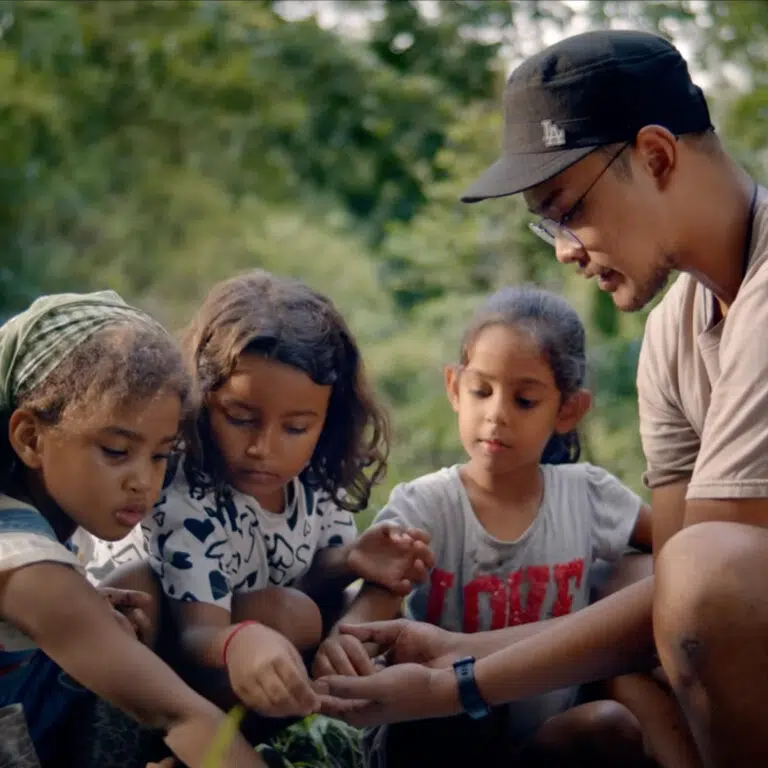
Caption: Grade 8 students gather at Green School Bali’s Heart of School to embark upon their Quest projects.
Off the tip of Canada’s Vancouver Island, an extinct volcano breaks the ocean’s surface, forming the Race Rocks islets and the infamous currents of Race Passage. Hundreds of shipwrecks mark it as one of the last places you want an engine to fail. So, there we were—wind rising, tide turning, dead in the water. The loss of power was immediately palpable as we had only minutes before the ebb current would pull us onto the rocks. Learning the prop was entangled in a ghost net, wrapped too tightly to be lifted out of the water and out of reach even when we dangled someone overboard by their feet, the next steps needed no discussion—a stern line was fixed so one of us with a knife-in-hand could get in the freezing water and try their best to cut through the net before time ran out. Times like this are among my favorite memories of school, of an education shaped by shared risk and possibility, where students and teachers depended on one another to do necessary things.
I reflect on that day now after some of my own students just spontaneously volunteered their verdict: to them I am an “NPC”. For the non-gamers, NPCs or non-player characters are scripted, predictable figures programmed as subsidiary elements of the main character’s experience. Describing a person, NPC refers to someone with “such little originality and brain power that they are the most bland human on the planet”. As these students are pursuing their own Quests, a Capstone project for Middle School, their phrasing wasn’t cruelty so much as clarity: nothing depends on the NPC’s response. In their ecology of learning, the adult no longer registers as a participant capable of shared experience.
Gregory Bateson reminded us that learning is not the accumulation of information but a change in the patterns of relationship that generate it. When schools are designed to minimize consequence, they also minimize learning. Co-evolution requires exposure, feedback, and mutual risk. Without these, character becomes a simulation. Only under certain conditions can character metabolize reality—and regenerative education is the work of cultivating those conditions. In the drifting boat, difference mattered immanently and immediately. Water speed. Current trajectory. Who could withstand the cold, churning water and effectively wield a knife. We understood that inaction mattered too.
Calling a teacher an NPC is something other-than adolescent insolence; it’s a sociological signal, a symptom of a system that no longer allows difference to make a difference. The tragedy is not that young people are cynical, but that they are perceptive. A role once held by trusted and respected adults—elders, mentors, dangerous storytellers—has been dehumanized by design.
Today’s learning ecologies are engineered out of relation with the real, much like climate-controlled rooms that ensure comfort over encounter. Teachers are buffered from students; students from one another; everyone from place. We compost nothing. We metabolize no failure. We passively progress through received systems mistaking smooth processes for healthy functions. When learning is stripped of mutual need—between people, between generations, between branches of the tree of life—attention floats free, unmoored. NPCs proliferate and the individual is increasingly alone and unchallenged in systems optimized to avoid being changed.
Difference is trending towards ornamental as we drift from the relational. Feedback is decoupling from dependence, at least we imagine it so: nothing bad happens if you disengage; nothing vital happens if you care. My Millennial education was shaped—painfully and beautifully—by hard truths, inevitable challenges, and common purpose. Expeditionary education understood something schools are forgetting: character emerges at edges. Edges ask something of us—attention, humility, response. Edges are not problems to be solved; they are invitations to relationship. In ecology, the edge effect concentrates diversity; where symbioses co-evolve, where communities learn how to learn. Remove the edge and you don’t get safety; you get malfunction. Character does not grow in protected interiors but where difference presses back. It isn’t surprising then that my NPC diagnosis was delivered at the Heart of School.
Character education claims to cultivate strength or resilience. But, strength without stakes is performance and resilience without exposure is fantasy. Bateson warned that severing feedback from the systems that generate it produces pathologies of learning: organisms trained for environments that no longer exist. If education is to recover its living function, it will not come from better scripts, but through the return of consequence, encounter, and shared becoming. A return to learning that is no longer safe because it is real. This is not nostalgia for hardship nor a call to romanticize danger. It is a refusal of the lie that care requires control. Living curricula—regenerative ones—do not scale neatly. They tangle peers with peers, mentors with learners, homes with schools, human with other-than-human agencies. They allow for failure that matters and success that costs something. They make adults legible as living beings because adults, too, are changed through encounter.
Returning to the MV Second Nature still adrift for a moment after the prop was freed, we understood our success was collective, provisional, and unfinished. There were no main characters. We were legible to one another because what we did mattered and what we failed to do would have mattered more. Merleau-Ponty’s phenomenology has it that we were not just situated in a shared world of concern, but oriented by felt availability in a reciprocal field. Mead’s semiotics might say something like ‘I am readable because my actions call forth yours’. To become legible again may require less performance and more exposure—being seen needing, choosing, and changing in the presence of others. No scripted roles, but living participants in unfinished systems of learning. Bateson’s “difference that makes a difference” best bridges the gathering and clarity meanings at the Proto-Indo–European root of legibility; to be legible is to perturb a system such that relationship becomes possible.
What I understand as a living curriculum is both a shared direction and adaptability, not a set of fixed goals or known endpoints. The Race Rocks are still there, still breaking the surface, still forcing water into relation with stone. The currents still rip. What made the difference that day was not bravery or grit but entanglement—lives caught in a moment that refused spectators. Education once placed us more often in such waters. If teachers now read as NPCs, perhaps it is because we have deflected the tidal flows, padded the rocks, and mistaken calm for care. But the edges remain, maybe sharper than before. The question is whether we will meet them together or continue drifting, anxiously detached until rocky bottoms make decisions for us. Regardless, we are entering more volatile and complex waters, where rigid designs are known to fail.
Written by Ryan M. J. Murphy