A little sparrow flits out of the bushes, rising lightly into the branches of a mature Camphor tree that leans over towards a small 20-square-metre site nestled among the food gardens by the Heart of School. In its beak is a slender twig, carefully chosen from a nearby dense patch of tall, vibrant purple and magenta Cockscomb herbs, Celosia argentea. It vanishes into the foliage, then reappears in a quick, buoyant flutter, pausing to scan the horizon – perhaps for richer foraging grounds, perhaps for lurking predators. Just a moment later, it drops swiftly back into the bush, rustling briefly before emerging with another gathering. Satisfied with its carefully selected find, it lifts itself once more to weave the twig into its steadily growing nest. Blink, and you might miss the entire performance.
This “sparrow” is, in truth, a Javan Munia – a delicate estrildid finch – and the newest arrival to a Middle School project site aptly named the Middle School Rewilding Area. Twelve months ago, this is exactly what a group of six students set out to create: an area of land left untouched by human hands, where nature could return, reclaim, and thrive.
Shaping
Let’s rewind to January 2025.
Six middle schoolers elected to take a Regenerative Design course, not knowing exactly what it would involve, but sensing – somewhere deep inside – that they wanted to pilot a project on campus that would be good for the planet and create genuine, positive change. Ironically, the first “flight path” of our Regenerative Design curriculum at Green School is named just that – sensing. Before I had even introduced the pedagogy with them, they were living it. Game on.
The weeks that followed required a deliberate slowing down. We observed and wandered. We gathered information and interviewed teachers, gardeners, students – just about anyone willing to pause and share. Eventually, three completely different ideas emerged.
The first was to solve the frequent problem of students needing to borrow a laptop charger because of dead batteries or simple forgetfulness. Their proposal was to create and manage a shared database where students could access real-time information about who had which type of laptop and charger on any given day, and which class they would be in – eliminating the need to run around the entire Heart of School in mild desperation.
The second idea was to tackle the issue of significant fine dust deposits that cover the seating areas in Sangkep, the school’s largest meeting space.
The third idea – the one that took root – grew from a conversation with Pak Kenny who, being the nature lover and advocate he is, pointed out that despite our vibrant and green campus, there is still an ecological imbalance and opportunity for more dead log habitats, where macroinvertebrates such as beetle larvae and other decomposers could thrive, and in turn be observed, appreciated, and studied by our students. After further deliberation and sensing, the students decided to develop this idea.
Thanks to Benjamin Freud, Andy Middleton, and Denise DeLuca, the students were able to access and use Biomimicry and Regenerative Design tools already available to teachers in the BiRD Lab Handbook. We explored Rich Pictures and Empathy Maps, considering the voices of past, present, and future generations – those directly and indirectly using the learning spaces around campus – as well as the more-than-human world, listening carefully to what nature might be saying.
At first, students were sceptical of the timeframe I had suggested for the Sensing phase. Many hours just to decide? In typical Green School spirit, they were ready to get stuck in straight away. And yet, to my quiet delight, by the end of this first design phase, they had begun to recognise both the reason for – and the depth of – this important foundation, one so often overlooked by policy-makers around the world. By learning to sense not just with open eyes and ears, but with open hearts, they were ready for the next phase.
Seeking
Without elaborating in too much detail, a core tenet of the Seeking phase is to frame a high-quality, meaningful question known as the Regen10, or R10 Question, inspired by the prompt: “If I took the context fully into account, what is it that I would set out to do if I knew that I couldn’t fail?” Time was spent reflecting, envisioning and questioning. We critiqued our intentions, and toyed with uncertainties until by the time we entered the third flight path, Shaping, students had a clearly articulated and compelling mission. Below is a glimpse into the refinement of our R10 Question – beginning with early-on ideas from students, and gradually evolving into something more focused and more transformative.
1st Iteration.
What environmental and community benefits could result from reducing palm tree plantations and other public spaces in Bali with rewilded systems that attract wildlife?
2nd Iteration.
Can ecosystems and wildlife help increase biodiversity, and how might this impact our community and our rewilding efforts?
3rd Iteration.
How much positive impact on human communities, biodiversity, and nature would result if public and private space owners strategically rewilded barren and underutilised areas of their land to attract wildlife?
4th Iteration.
If barren and suboptimally used spaces were intentionally rewilded, how could this transform relationships between human communities and the more-than-human world?
Shaping

Sub-dividing the garden for a range of habitats
“I can find big rocks and use a very strong, eco-friendly glue to stick them together and let them dry until they’re stuck together. I can fit more than one, and I can vary the shapes and designs for each cave for different species. Also, under some I can put dry leaves and under another nothing and under another something else, etc. So I need to find rocks. I don’t know what I should use instead of super glue, maybe aquarium glue?”
Student Journal
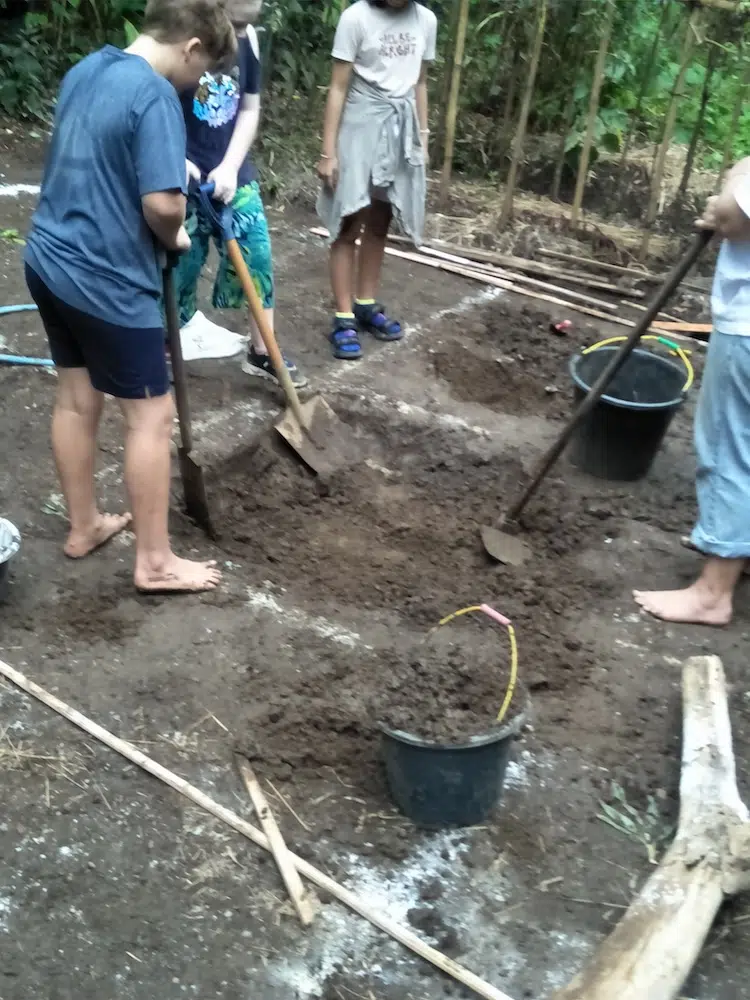
By now, the garden lot had been subdivided into a range of habitats, including the aforementioned rock pile habitat, as well as aquatic, pollinator flower, underground, rotting log, avocado tree, and bug house zones. As part of the discussions around this project – and drawing on our learning from initiatives such as coral restoration projects around Bali and the Junglo Miwauke forest rewilding projects – students recognised that there is often a nursery or preparatory phase in which an area is carefully set up to support its intended ecological outcome. Without taking too much agency away from Mother Nature, they decided to design nine distinct mini-habitats to encourage the growth of different flora and attract a greater diversity of fauna. After all, biodiversity is often richest along the margins where different habitats meet.

Middle schoolers readying the land in preparation for the most exciting part of the project: waiting to see what Mother Nature might have in store.
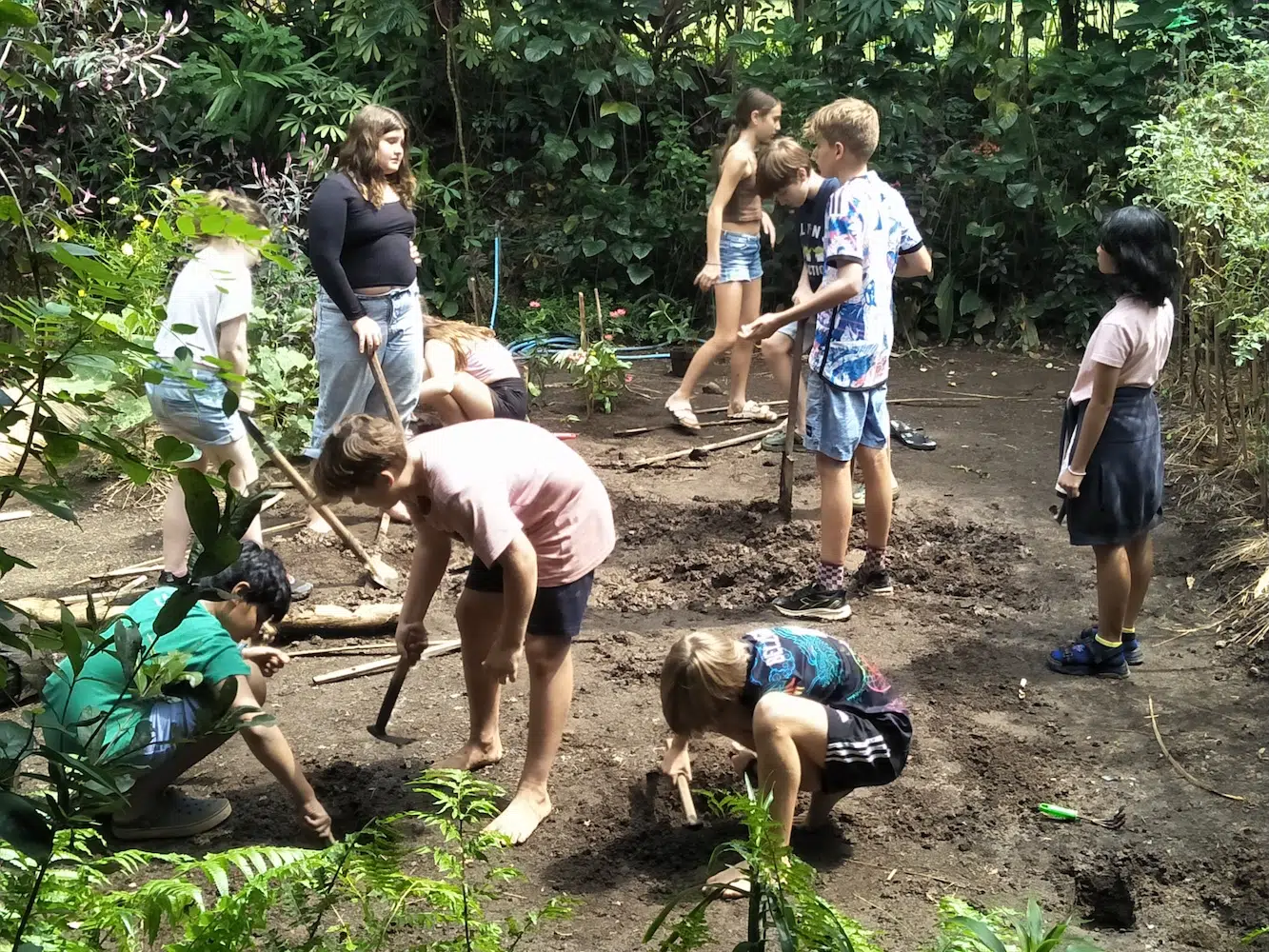
It is worth noting that the Shaping phase typically takes on a strong Biomimicry focus. Ordinarily, more time would be spent exploring the eddies that spin off the Biomimicry Design Spiral, as students seek inspiration for innovation by learning from nature’s designs, processes, and strategies. However, timetable constraints posed real challenges. By this stage, we were working with our third cohort of students since the project began, and we were only seeing them once a week for an hour. The risk of losing traction and momentum was real. These students were eager – ready to dig, to get their hands and feet muddy – and so we did not spend as much time exploring biomimicry as we might have hoped. However, not all was lost. The most powerful biomimicry lesson was quietly emerging: how would nature reclaim, revegetate, and re-lush this space on her own terms?

Ready and waiting to see what unfolds after the holidays
Storytelling

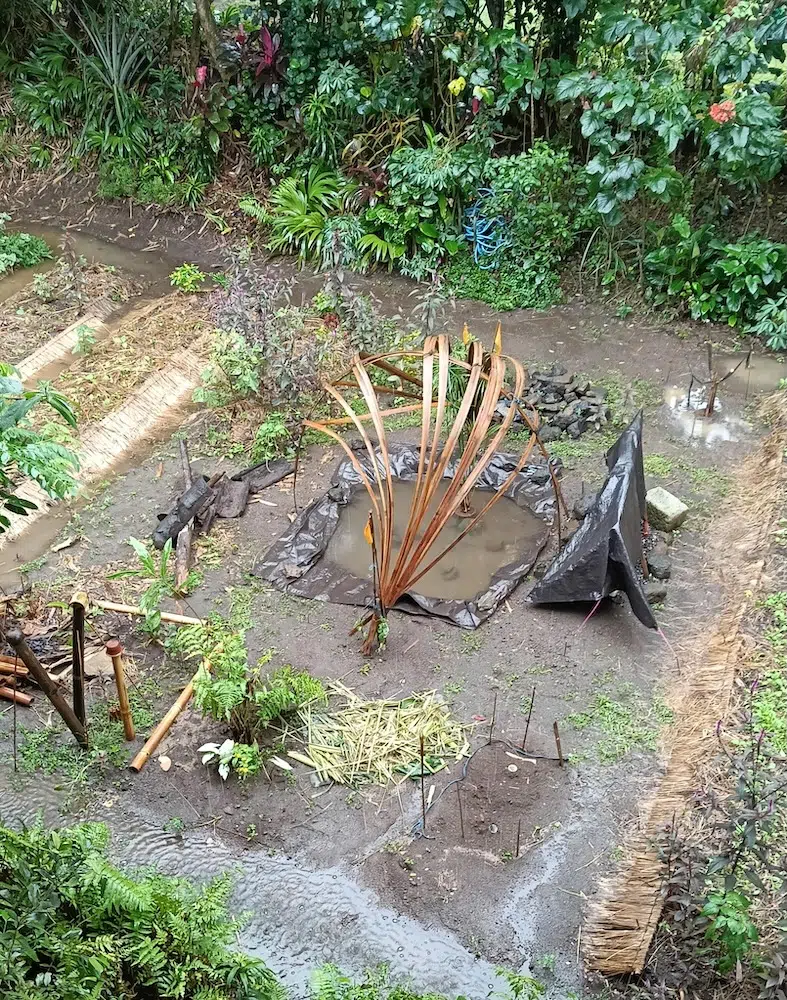
Rewilding happening! Finding surprises after returning to school in Semester 2
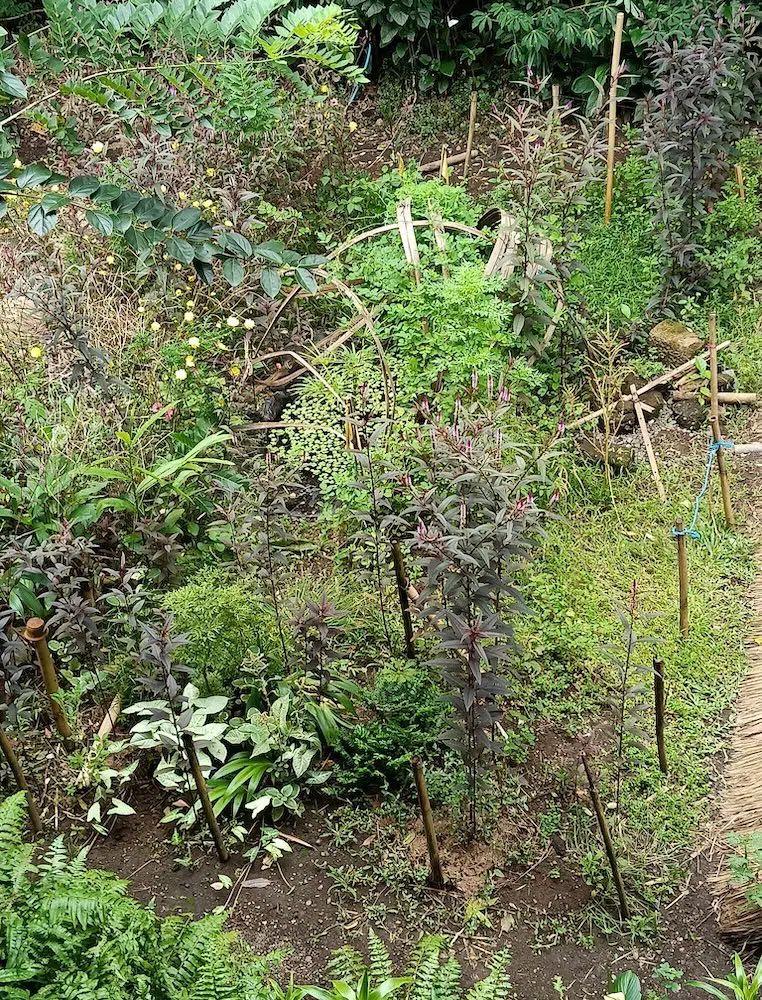
Being greeted by this sight on returning for Semester Two was both a surprise and a delight, to say the very least. Despite not having grandchildren of my own, I suddenly felt like the overseas grandpa who sees them only once a year. “Oh my! How you’ve grown! Look at those strong legs and arms! Wow – your feet are nearly the size of Mummy’s now!”
It led me to a reflection – perhaps an obvious one – yet I wonder how often it is overlooked, and how deeply it is needed in today’s world. When we invest time, love, and care in nurturing another living thing – whether tending a pet, guiding a stranded fish from a drying rockpool back to the sea, growing vegetables from seed, or committing to a rewilding project – something shifts within us. A deeper connection forms. The ego steps back, and we begin to recognise ourselves as part of a wider, more generous field – more honestly connected to the planet we share and belong to.
There is something therapeutic in this. A quiet sense of belonging. A softening into a steadier, more attentive presence. I feel my senses sharpening, a greater embeddedness in my surroundings. I am hearing nature differently, not as a metaphor, but as a relationship. It reminds me of standing on an isolated summit, or being sixty feet underwater on a single breath – moments of heightened awareness and clarity. Only this time there is an added sense of gratitude and quiet fulfilment, knowing that I – and my students – have helped create the conditions in which life is now flourishing all around us.
The next time I invite my students to experience an activity called “Ask a Pinecone,” and they look at me with understandable scepticism, I won’t rush to defend it. I’ll explain that the exercise is not about pretending pinecones speak. It is about practising attention – learning to observe form, structure, adaptation, and response. It is about asking better questions of the more-than-human world and allowing our thinking to be shaped by what we notice. And how I can use this rewilding journey experience to relate this to is by sharing with them that this understanding has not come quickly for me. It has taken time – moving through the full arc of the rewilding process, waiting, observing, watching it slowly come to fruition. It has required deliberate stillness: standing quietly in the rewilded space, suspending judgment, and simply paying attention. In that neutrality, something subtle begins to happen. Thoughts surface that feel less imposed and more discovered. Feelings of care and connection grow not because I manufacture them, but because I have made space for them.
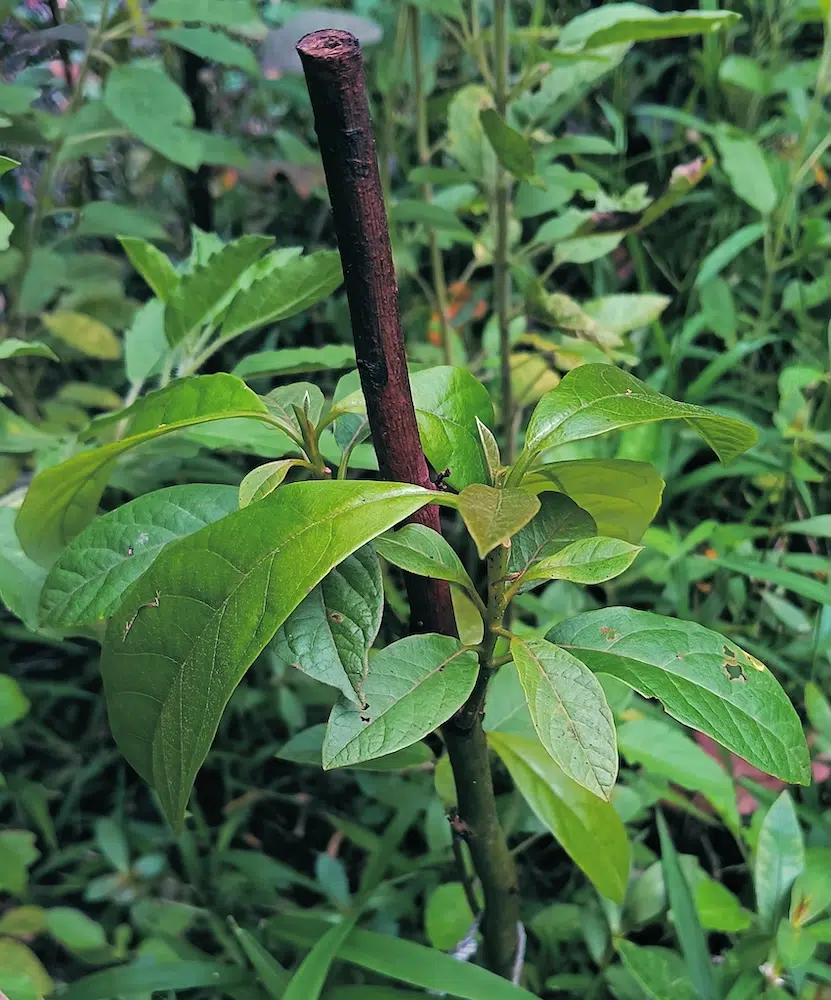
Of course, there are a multitude of scientific and practical discoveries to be made too! As I look around the rewilding area, I find my baby avocado tree – the one I transplanted from my garden at home as a donation to our “tree habitat.” In my garden, it stood nearly head-high, with ten or so large oval leaves spaced evenly along its stem in a generous, confident, architectural form. But when I moved it, it had been in the middle of a hot drought and within weeks, the top two-thirds burned and crisped, leaving just a sad knee-high wilted stump. It had succumbed to desiccation and drought. Or so I thought.
The wet season arrived – two months of steady rain and cloud, and still counting. That’s when I noticed something. The bottom third – the part I had assumed was merely lingering – had begun to push out new leaves. But not the same large oval ones as before, nor the same strategy. This time they were smaller. Closer together. Growing in tight, self-shading clusters of four and five. The long, confident spacing had gone. The architecture had changed. The tree had clearly learned something and was responding – and once again I found myself standing in this 20-square-metre space, in awe and appreciation, taking lessons from nature. I was observing that under abundance, the tree expressed expansive architecture. Under shock, it retreated and protected its core. Under recovery, it rebuilds smaller, tighter, more efficient and conservative leaves, with less surface area, more clustering, and self-shading. Strategising for a different environment in its own botanical way.

Noticing changes
This blog marks the first Storytelling of this rewilding project, and like anything that grows, adapts, and evolves over time, countless more stories await.
Next week, we begin digital mapping with our honoured guest, Daniel Kinzer, who is spending a fortnight on campus contributing to regenerative and biomimicry-inspired projects. And I hope that soon, students will be sharing their lived experiences in the next wave of discoveries. Balinese gardeners who have tended these grounds for over a decade have expressed their intrigue, fascination, and approval of what is unfolding to me directly. Perhaps – like the Whanganui River in Aotearoa, New Zealand – this space might one day be granted its own form of rights, a concept currently being discussed by the Middle School Student Association.
This project has been part of a broader shift toward a more-than-human perspective – a move away from the idea of the “non-human,” which subtly keeps humans at the centre of everything. A more-than-human worldview recognises that ecosystems – living and non-living alike – follow their own patterns, processes, and forms of agency. It invites us into partnership rather than ownership, participation rather than control.
As one student put it, in beautifully simple language:
“Humans need healthy natural ecosystems; healthy natural ecosystems need thoughtful human participation.”
The questions now arising feel both practical and profound:
- Can schools become biodiversity nodes?
- Can rewilding and food systems merge?
- Can a campus landscape become a teacher in its own right?
- What other accessible to everyone projects, simple on the outside – deep on the inside, can schools explore?
- How can we honour the ancestry of the living things that came before us on this land, and how can we be good citizens and pay it forward to future generations?
- If barren and suboptimally used spaces were intentionally rewilded, how could this transform relationships between human communities and the more-than-human world?
- How does the everyday vernacular of a society shape its consciousness – and what words are we choosing in this moment?
- Should I stop using the term non-human altogether?
I have to consider that last question before walking into my next class.
Personally, I believe it is still appropriate to use either non-human or more-than-human, depending on context. Is this not more about emphasis than belief? One can be philosophically aligned with a relational, reciprocal, regenerative worldview and still say “non-human species” in a science lesson, while choosing “more-than-human” when the intention is to decentralise the human and highlight participation within living systems.
The philosophy lives in how we perceive and experience the relationship, not only in the label we choose.
A Zebra Dove bobs and hops daintily along the ground in front of me – the latest amniote to arrive at our rewilding site – already rendering my second paragraph in this blog redundant. It seems unfazed by the students and faculty walking only metres past, as if realising it is in a peaceful haven. I want to call out in excitement, “Look, yet another species using our space!” But instead, I stop and watch, aware that the living world will continue its narrative whether or not I announce it – and that this is only the first chapter.
Written by Olivier Bourdon