
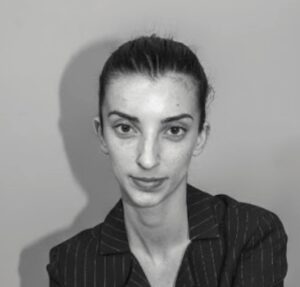
Bronwen is a multidisciplinary architect, artist and designer working at the intersection of ecology and bio-material innovation. Her works have been showcased at the Green Design Show, Melbourne Exhibition Centre, and Linden New Art Gallery. The City of Melbourne recently engaged Bronwen to enhance the city’s artistic and cultural landscape with her sculptural proposal, “Flourish: Hemp-Fuelled Urban Oases,” which will be exhibited in 2025.
Before completing her Master of Architecture at the University of Melbourne, Bronwen studied Contemporary Art in New York and later became an Ambassador in the Visitor Experience Team at the Metropolitan Museum of Art. During this time, this museum welcomed 7 million visitors annually.
She has lectured and taught design studios, technology, history, and theory at the Melbourne School of Design and the Monash Faculty of Art, Design & Architecture.
With business partner Frank Burridge, Bronwen cofounded MAIN&FRANK, a design company that creates architecture, art, masterplans and material systems that build resilience in place, grounded in bioregional intelligence, regeneration and stewardship.
MAIN&FRANK projects are guided by three principles: Collaborative; Nature-based; Living.
They help organisations adapt to uncertain futures and support communities to thrive in complex environments by strategically integrating their aspirations with ecological thinking, transforming strategy into masterplans and projects that build real resilience, close the loop on waste, sequester carbon, regenerate habitat and provide myriad cascading benefits to the community and environment.
Their projects range from regenerative learning environments and masterplans to public artworks, flat-pack construction systems, prototypes and bespoke designs. They innovate with regenerative biomaterials including hemp, straw and biochar, treating material practice as a platform for community development, habitat creation, climate-responsive performance and public health.
MAIN&FRANK projects do not just withstand uncertainty but get better through adaptation, care and ecological reciprocity, creating cascading benefits for communities, local economies and ecosystems over time.